
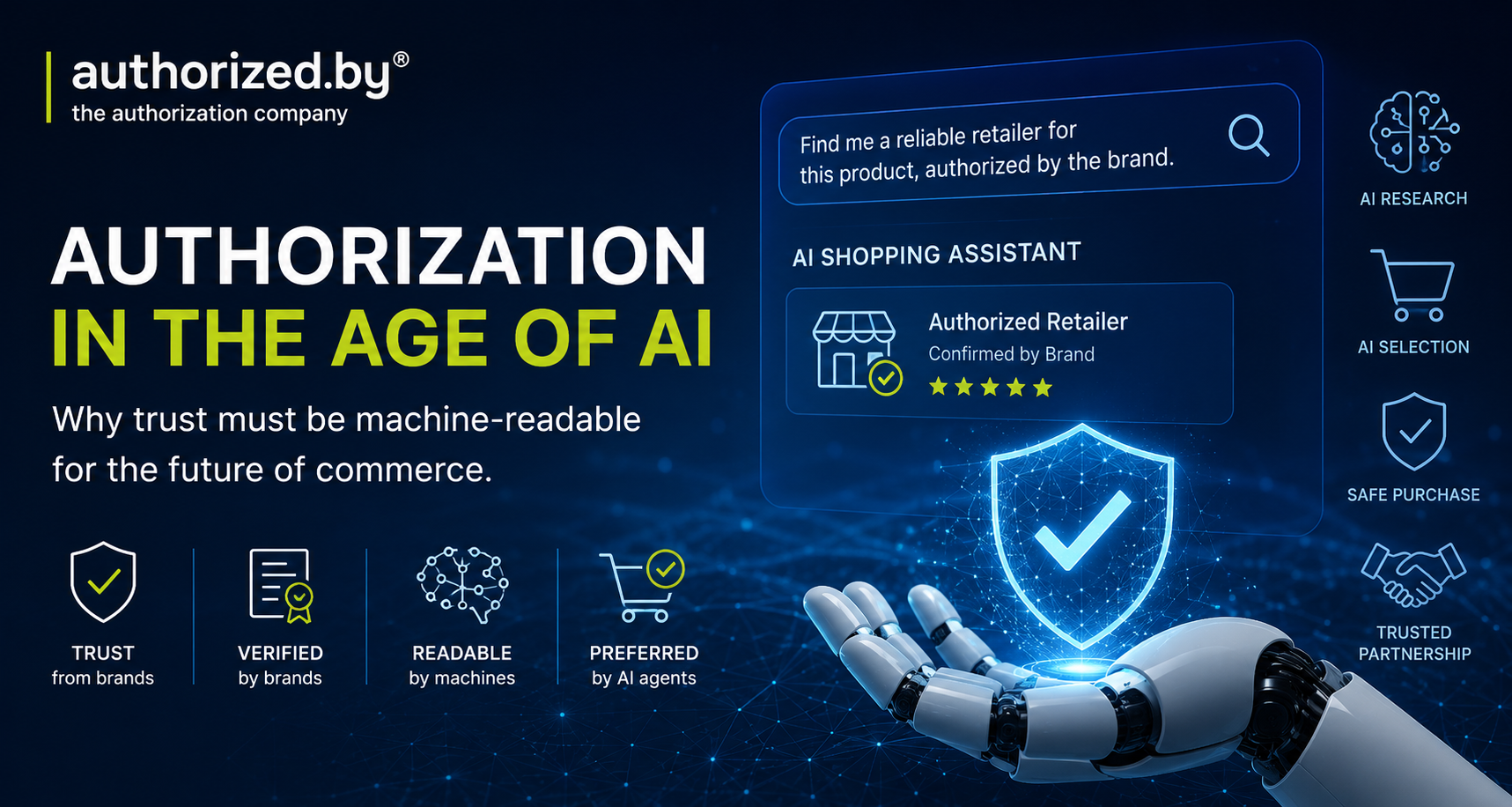
Authorization in the Age of AI: Why Trust Must Become Machine-Readable
The way people search for, compare and purchase products is undergoing a fundamental transformation.
For many years, a purchasing decision usually began with a search engine. Consumers entered a product name, opened several results, compared prices, read reviews and then decided for themselves which retailer they trusted.
Today, a growing share of this research is moving into AI systems and large language models.
Users are no longer simply asking:
“Where can I buy this product?”
Instead, they formulate complete requirements:
“Find me a reliable retailer for this product that delivers to Germany, offers a good price and is officially authorized by the manufacturer.”
The AI system increasingly takes over tasks that consumers previously performed themselves. It researches, compares, evaluates sources and reduces a large number of possible offers to a small selection of recommendations.
This development will not stop at research. AI systems will increasingly select products, prepare shopping carts and support or complete purchases on behalf of their users.
Shopping through AI agents is therefore developing from a future scenario into a new part of digital commerce infrastructure.
From search engines to personal shopping agents
A search engine provides links. An AI assistant increasingly provides a specific answer.
This difference is significant.
With a traditional Google search, users decide for themselves which results to open, which providers to investigate and where they ultimately want to buy. An AI system, however, can make several preliminary decisions before the user ever visits a shop:
- Which products match the request?
- Which retailers qualify as potential sources?
- Which sources appear reliable?
- Which offers are mentioned at all?
- Which providers are excluded?
- Which retailer should fulfil the purchase?
The next stage of development is already foreseeable. People define an objective, a budget and certain requirements. The AI agent performs the research, evaluates the providers and may also complete the order.
The retailer will then no longer compete only for the attention of a person.
The retailer will compete to be recognized by an AI system as a suitable and trustworthy source.
Trust will become a decisive success factor
The success of a search engine was never based solely on indexing as many websites as possible.
The quality of the results was decisive.
People used Google because they trusted that the first results would provide relevant answers. The more reliable those results appeared, the more frequently the search engine was used.
A similar principle applies to AI systems, but with even greater consequences.
An AI assistant that merely recommends information can be corrected. A shopping agent that selects products, processes personal data or initiates an order on behalf of a person carries significantly more responsibility.
For people to use these systems permanently, the results must not only be convenient. They must also be:
- relevant,
- transparent,
- safe,
- up to date and
- trustworthy.
Trust is therefore considered a fundamental requirement for the broad adoption of AI and agentic systems. This is particularly true when AI no longer simply provides information but prepares or executes decisions independently.
This creates a new question for digital commerce:
Which information can an AI system rely on when assessing a retailer?
A professional-looking shop is not necessarily a trustworthy retailer
In traditional ecommerce, trust has often been communicated visually.
A professional design, high-quality product images, familiar payment methods, customer reviews, trust seals and a convincing brand experience are intended to signal to consumers:
“You can shop safely here.”
These elements remain important as long as a person visits the shop and makes the decision.
However, an attractive website is not reliable evidence of an official business relationship between a brand and a retailer.
With modern shop systems, templates and generative AI, almost any provider can create a professional-looking online shop within a short period of time. Unauthorized retailers, grey-market sellers and fraudulent shops can also appear visually convincing.
The appearance of a shop therefore does not answer the decisive question:
Has this retailer actually been confirmed by the relevant brand as an authorized retail partner?
authorized.by® makes precisely this relationship visible. Authorization is granted by the brand. The retailer cannot assign or independently change its own status.
If the brand revokes or ends an authorization, the publicly verifiable status also changes.
What people see and what machines understand
A person often recognizes a trust signal visually:
- a seal,
- a certificate,
- a brand logo,
- a positive review,
- a professional design.
An AI system also requires structured and clearly attributable information.
It must be able to identify technically:
- Which retailer is being referred to?
- Which brand confirmed the retailer?
- Which domain is covered by the authorization?
- Is the partnership currently active?
- When was the status last updated?
- Where can the reference source be found?
- Can the information be independently verified?
- Does the statement come from the retailer itself or from the brand?
This changes the value of digital trust signals.
A visible seal remains relevant to people. For AI systems, however, the information behind the seal becomes increasingly important.
It is not enough for the visual representation to be available. The underlying statement must also be accessible:
This brand currently confirms this retailer as an authorized retail partner.
Why authorization is a distinctive trust signal
A great deal of the information about an online shop comes from the retailer itself.
The retailer describes its company, maintains its product data, formulates its service promises and decides which awards or seals to display on its website.
A brand authorization is fundamentally different.
It is not a self-declaration by the retailer.
It is the documented statement of another business party: the brand.
Authorization therefore describes a real relationship between two companies:
- the brand as the confirming party and
- the retailer as the authorized retail partner.
For an AI system, the origin of this information is crucial.
The statement “We are an official retailer” is initially a claim made by the shop.
The statement “The brand confirms this retailer” is information that can be verified through an external source.
This is precisely what can make authorization a valuable signal when assessing a provider.
Authorization does not automatically mean that every offer is the cheapest or that every transaction will proceed without problems. It does, however, document that the retailer is part of a distribution relationship confirmed by the brand.
Price will remain important, but safety will become a selection criterion
Price will remain an important factor in AI-supported purchasing.
However, the lowest price is not automatically the best result.
An AI agent may also need to consider:
- Is the provider a real company that can be legally contacted?
- Is there an official relationship with the brand?
- Does the offer come through a regular distribution channel?
- Has the retailer been confirmed for the relevant sales channel?
- Is the underlying information current?
- Can the source be verified technically?
- Are there indications of grey-market or counterfeit risks?
- Can the status be traced in the event of a later complaint?
A good purchasing result is therefore not necessarily the cheapest offer.
It is the offer that combines price, availability, service, safety and trustworthiness in a meaningful way.
The more AI systems participate in purchasing decisions, the more important clearly referencable security and trust information will become.
From visible signals to referencable facts
In traditional ecommerce, retailers primarily had to be convincing to people.
In AI-driven commerce, they must also become understandable to machines.
This does not mean that shop design, branding or user experience will become irrelevant. Once a customer visits the shop, these factors will remain important for conversion.
Their role will, however, change.
If an AI agent decides which retailers qualify before the user ever visits a shop, visual trust signals only begin to have an effect after a technical preselection has already taken place.
A referencable authorization can potentially be considered during that preselection.
A digital authorization is:
- clearly attributable to a specific brand and retailer,
- confirmed by the brand,
- available as a current status,
- digitally verifiable,
- referencable as a source and
- available in machine-readable form.
This transforms a visual trust signal into digital information that can also be processed outside the retailer’s shop.
Machine-readable authorizations at authorized.by®
authorized.by® does not only display confirmed brand-retailer relationships through real-time seals, the public directory and digital certificates.
Current authorization information is also made available in machine-readable form through technical interfaces and MCP infrastructure.
This allows search engines, marketplaces, large language models and AI agents to technically retrieve the confirmed relationship between a brand and a retailer and reference it as a source.
The digital retailer and partnership certificates also create publicly accessible reference points.
An AI system can therefore potentially retrieve information about:
- which brand confirmed the retailer,
- which current status applies,
- which domain the authorization belongs to and
- whether the relationship remains active.
Further information about the technical provision of authorization data can be found in the authorized.by® FAQ.
This does not guarantee that a particular AI system will include, mention or preferentially recommend a retailer.
However, authorization creates a structured data foundation that automated systems can potentially consider as an additional trust signal.
Participation is free for retailers
Basic participation in authorized.by® is free for online retailers.
Retailers can create a profile, ask their partner brands for confirmation and request authorizations. Once a brand confirms the partnership, the relationship becomes visible in the retailer profile, the corresponding certificate and the “Ask the Brand” directory.
The machine-readable provision of confirmed authorization information is also part of this network.
Paid services add further functions, visibility options and services to the free participation model.
Access is deliberately designed to be straightforward:
Every retailer should have the opportunity to have genuine brand relationships officially confirmed and made digitally verifiable.
Register with authorized.by® for free
Why retailers should act now
Agentic commerce is still at an early stage of development.
However, the underlying technical infrastructure is already being created.
Products, providers, retailer data and trust information will increasingly need to be available in structured and machine-readable form.
Retailers should therefore not wait until AI agents already influence a significant proportion of purchasing decisions.
The essential foundations can be established today:
- Keep company data up to date.
- Clearly associate the relevant shop domain with the company.
- Have brand partnerships confirmed.
- Build digital certificates as reference sources.
- Provide structured product information.
- Enable technical accessibility for AI systems.
- Make trust signals not only visible but also verifiable.
Will authorization become an entry ticket to the digital value chain?
Today, a confirmed retailer authorization is an additional trust signal.
In the future, it may become significantly more important.
If AI agents independently select providers, they will require criteria that allow them to distinguish trustworthy sources from unknown or unconfirmed retailers.
A machine-readable brand authorization offers a distinctive quality:
It comes directly from the brand, can be assigned to a specific retailer and can be checked as a current status.
It is therefore conceivable that verifiable brand-retailer relationships will increasingly influence different processes:
- the selection of sources by AI shopping agents,
- recommendations made by AI assistants,
- retailer verification on marketplaces,
- automated risk and compliance processes,
- search and information systems,
- digital procurement processes,
- the preselection of official retail partners.
Authorization may therefore gradually develop from a visible shop signal into an entry ticket to the digital value chain.
Not because every AI system will necessarily favour authorized retailers.
But because systems can only take information into account if that information is digitally available, clearly attributable and technically accessible.
Retailers that do not document their trustworthiness in a machine-readable form risk becoming invisible or impossible to assess reliably for automated systems.
Brands also have a responsibility
This development does not only affect retailers.
Brands decide which partners belong to their official distribution network. They therefore hold information that is becoming increasingly valuable to consumers, marketplaces and AI systems.
By digitally authorizing their retail partners, brands can:
- make their official retailers clearly visible,
- distinguish unauthorized providers more clearly,
- show consumers safer sources of supply,
- strengthen trusted partners in digital competition,
- represent their distribution structure in machine-readable form,
- provide AI systems with a verifiable source,
- document changes and revocations as current status information.
The brand therefore becomes the authoritative source for determining which retailer is actually part of its official network.
Learn more about retailer authorization for brands
Trust requires a verifiable origin
In the age of AI, the decisive question will not only be which information is available.
It will also be where that information comes from.
- A product description usually comes from the retailer or manufacturer.
- A review comes from a customer or platform.
- An identity check confirms the company behind a shop.
- A retailer authorization comes from the brand and documents the business relationship with its retail partner.
Only the combination of such sources enables a robust assessment.
For AI systems, provenance – the traceable origin of information – will therefore become a significant quality criterion.
Trust is not created by the sheer volume of data. It is created by current, verifiable and clearly attributable information.
Conclusion: Trust must be visible to people and readable by machines
Digital commerce is facing a fundamental transformation.
Product research is increasingly moving from traditional search engines to AI assistants. The next step will involve agents that compare products, select providers and complete purchases on behalf of their users.
This also changes the role of trust.
A professional shop, a competitive price and a visible seal will remain important. However, they are not sufficient when an automated system needs to determine which provider is a trustworthy source.
That requires referencable facts.
A retailer authorization confirmed by the brand is such a fact.
authorized.by® makes this relationship visible, verifiable and machine-readable for consumers, search engines, marketplaces, large language models and AI agents.
Participation is free for retailers. Every confirmed authorization expands the digital data foundation that automated systems can potentially use.
A recommendation by a particular AI system cannot be guaranteed.
However, one point is clear:
Information that is not digitally documented, referencable and machine-readable is difficult for AI systems to consider reliably.
Authorization is therefore becoming an important building block for trust in AI-driven commerce – and potentially a future entry ticket to the digital value chain.
Register with authorized.by® for free
Explore “Ask the Brand” and the official directory
Discover Authorization as a Service for marketplaces
Further reading and sources
- NIST: AI Risk Management Framework
- OpenAI: Shopping and purchasing in ChatGPT
- OpenAI Developers: Commerce
- McKinsey: Europe’s agentic commerce moment
- authorized.by® FAQ

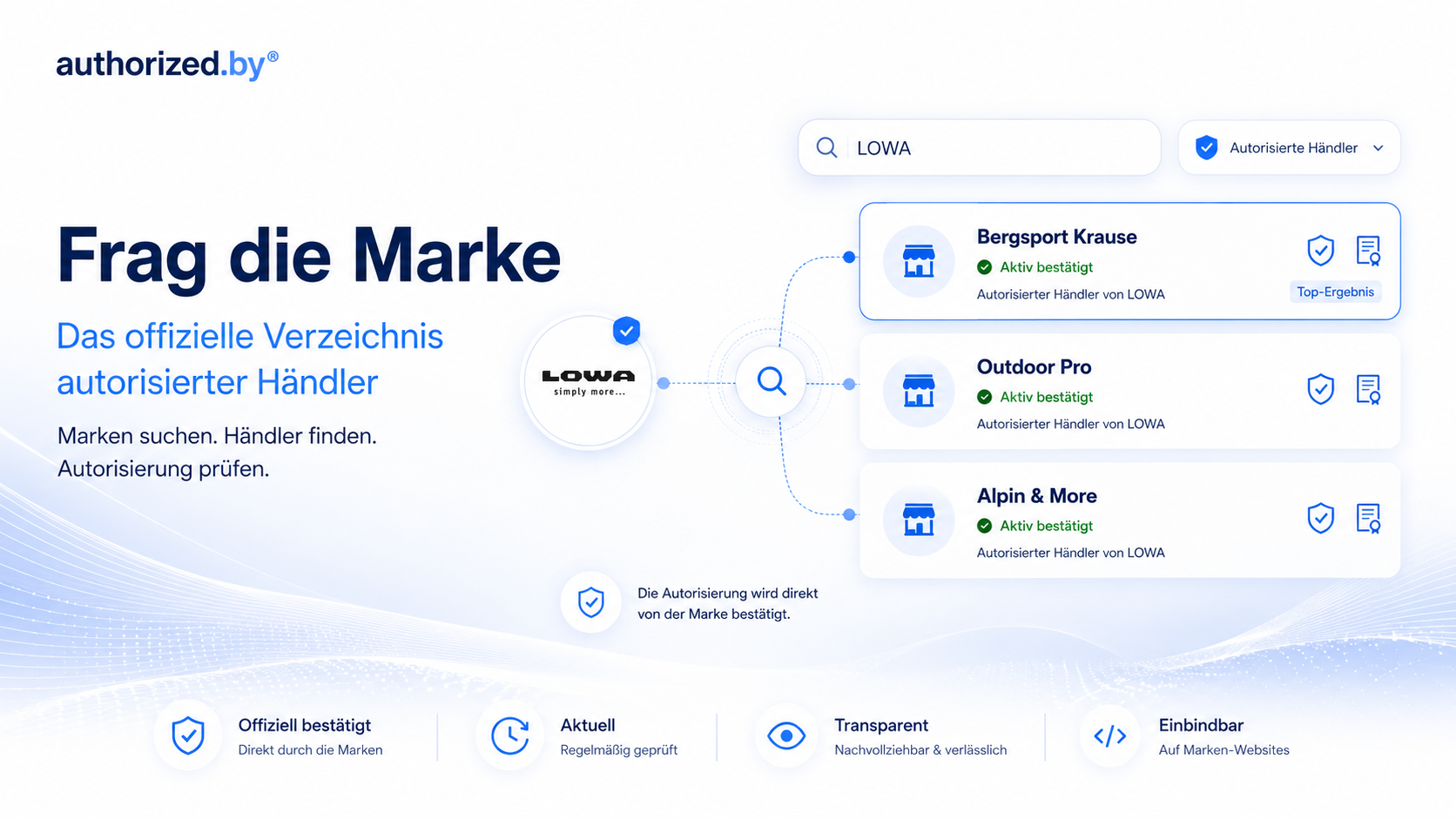
Find Authorized Retailers with "Ask the Brand"
Anyone who wants to buy a branded product online often faces one decisive question:
Is this online shop actually an authorized retailer of the brand?
With the new retailer search "Ask the Brand", consumers now get a clear and up-to-date answer. The search shows which retailers have been officially confirmed by a brand as distribution partners.
One decisive principle applies:
It is not the retailer who declares itself an authorized brand partner. The authorization is granted exclusively by the brand.
This creates an official, brand-controlled directory of authorized retailers, online shops, and brand partners.
What is an authorized retailer?
An authorized retailer is a company whose sales relationship has been officially confirmed by a brand or manufacturer.
Terms such as "authorized retailer", "official retailer", "authorized online retailer", or "official brand partner" are widely used in e-commerce. For consumers, however, it has often been difficult to verify whether these claims were actually confirmed by the brand in question or merely based on the retailer's self-presentation.
This is exactly where authorized.by® comes in.
Brands manage and confirm their retailer partnerships directly via the platform. Only a currently valid authorization confirmed by the brand can appear in the "Ask the Brand" retailer search.
How does "Ask the Brand" work?
Using the retailer search is simple:
- Consumers enter the name of a brand or a shop.
- The search matches the query against the confirmed authorizations on authorized.by®.
- The results show the retailers whose partnership is currently confirmed by the respective brand.
- Via the retailer profile and the associated certificate, the authorization can be examined in more detail.
In this way, consumers can specifically search for official and trustworthy sources for a brand.
Which retailers are displayed?
"Ask the Brand" shows only active and confirmed brand-retailer relationships.
Not displayed are:
- requests that have not yet been confirmed,
- paused partnerships,
- expired authorizations,
- revoked authorizations,
- retailers without confirmation from the searched brand.
If an authorization is changed or withdrawn by the brand, this change is immediately reflected in the public display.
This means it is not a static retailer list, but continuously updated authorization information.
Every confirmed partnership is automatically included in the search. This generally applies regardless of whether a free or paid authorized.by® package is used.
Why should you buy from an authorized retailer?
Buying from an officially authorized retailer can be important for consumers in several respects.
1. A traceable source
The confirmation shows that an officially confirmed sales relationship exists between the retailer and the brand.
2. More guidance before the purchase
Especially with unfamiliar online shops, the retailer authorization can be an additional signal to better assess a provider.
Brand authorizations confirmed via authorized.by® can also be taken into account as a positive signal in the Fakeshop-Finder of the German consumer advice centres (Verbraucherzentrale).
3. Relevance for service and spare parts
Depending on the product and brand, the choice of sales partner can influence which services, contacts, or spare parts offerings are available after the purchase.
4. Distinction from grey market offers and unauthorized sellers
A low price does not automatically mean that a retailer is part of a brand's official distribution network.
"Ask the Brand" creates transparency about which sellers have actually been confirmed by the brand.
Authorization is more than a retailer's claim
Many online shops use phrases such as:
- "official retailer",
- "certified specialist retailer",
- "brand partner",
- "genuine products from a specialist retailer".
Such statements are not always directly verifiable for consumers.
An authorization documented via authorized.by® differs fundamentally: the status is granted by the brand itself, managed centrally, and checked for currency when displayed.
In addition, every confirmed brand partnership is linked to a digital certificate. This means the status can be verified and referenced not only in the shop, but also independently via authorized.by®.
Benefits for authorized retailers and online shops
For retailers, an existing brand partnership becomes easier to find through "Ask the Brand". Anyone who wants to become visible as an authorized brand partner benefits in several ways.
Visibility at the moment of the purchase decision
Consumers searching for an official retailer of a specific brand already have a concrete interest. The retailer search connects confirmed sellers with exactly this search intent.
Distinction from unauthorized competitors
A retailer can visibly demonstrate that the relationship with the brand has actually been confirmed.
A publicly referenceable retailer profile
The retailer profile bundles the confirmed brand partnerships and links to the corresponding authorization certificates.
Visibility in search engines and AI systems
Confirmed authorization data is not only displayed on the website. authorized.by® also makes this information available in machine-readable form via open interfaces such as API and MCP for search engines, marketplaces, and AI assistants. In this way, the confirmed brand-retailer relationship can be provided technically as structured, referenceable information.
A specific placement or recommendation by a search or AI system cannot be guaranteed as a result. However, this creates an unambiguous data foundation that goes beyond a mere self-declaration by the retailer.
Benefits for brands and manufacturers
For brands, too, "Ask the Brand" is far more than a public retailer list. How brands officially authorize their retailers is explained on the service page for brands and manufacturers.
Make the official retailer network visible
Every confirmed authorization becomes part of the brand's publicly visible distribution network.
Full control over the status
Which retailers are authorized is decided exclusively by the brand. If a partnership ends, the authorization can be updated or revoked accordingly.
Display retailers on the brand's own website
Brands can integrate the search for their authorized retailers directly into their own website.
The results remain connected to the authorized.by® database and are updated automatically. This means no separate retailer list has to be maintained manually.
Guide consumers specifically to official partners
The brand can direct customers straight to its confirmed sales partners and more clearly separate unauthorized sellers from the official network.
Is "Ask the Brand" a retailer search near me?
"Ask the Brand" is not a traditional geographic radius search.
The focus is not on a retailer's distance, but on the question of whether the retailer has been officially authorized by a specific brand.
This also allows consumers to find authorized online retailers that deliver regionally or nationwide.
What do PREMIUM partner and TÜV-ShopIdent mean?
Some retailers are additionally highlighted in the search as PREMIUM partners.
The PREMIUM status refers to the specific partnership between a brand and a retailer. It shows that the brand has additionally qualified and distinguished this sales partner.
Optionally, a PREMIUM partner may also hold the TÜV-ShopIdent. In this case, the identity of the provider has been verified in the designated procedure.
The actual foundation, however, always remains the authorization confirmed by the brand.
How can retailers improve their visibility?
Retailers should first make sure that their authorized.by® profile is complete and up to date.
This includes in particular:
- company name and shop domain,
- logo and retailer description,
- contact information,
- correct shop and company data,
- confirmed relationships with the brands carried.
Existing brand relationships that have not yet been confirmed can be requested directly via the platform.
The more complete the retailer profile, the better consumers and potential brand partners can assess the company.
How can brands build their retailer search?
Brands can invite their existing sales partners via authorized.by®, review requests, and manage confirmed retailers centrally.
As soon as an authorization is active, the retailer relationship automatically becomes visible in "Ask the Brand". No additional manual transfer to the public search is required.
Using the basic authorization function and having confirmed retailers included in the search is already possible with the free entry-level package.
Frequently asked questions about "Ask the Brand"
Is every retailer in the search automatically authorized?
No. Only retailers whose partnership has been actively confirmed by the respective brand are displayed.
Can a retailer register itself as authorized?
A retailer can request an authorization. However, only the respective brand can grant or revoke the official status.
Are free retailer and brand accounts displayed?
Yes. What matters is the active confirmation of the partnership, not the booked package.
How quickly does a new authorization become visible?
After approval and technical processing, a new authorization can usually appear in the search within a short time. Changes to the partnership status are reflected immediately.
What happens when an authorization is revoked?
If the authorization is terminated, paused, or revoked, the partnership is no longer displayed as active.
Can brands embed the retailer search on their website?
Yes. Brands can integrate the results for their authorized retailer network directly into their own website. Changes are then automatically taken over from the central data source.
Does an authorization guarantee genuine products?
The authorization confirms the official retailer relationship with the brand. It is therefore an important piece of information about the retailer's distribution status. However, it does not replace a check of a specific individual product or purchase.
Conclusion: Ask the brand first, then choose the retailer
Anyone looking for an official retailer, an authorized online shop, or a trustworthy source for a branded product needs reliable information.
"Ask the Brand" delivers this information straight from the source:
The brand decides which retailers belong to its official distribution network.
This is how authorized.by® creates a central, up-to-date, and verifiable directory of authorized retailers – for consumers, brands, shops, search engines, and AI systems.
Want to know which retailers are officially authorized by your brand?
Are you a retailer or brand manufacturer?
Register for free and confirm partnerships →
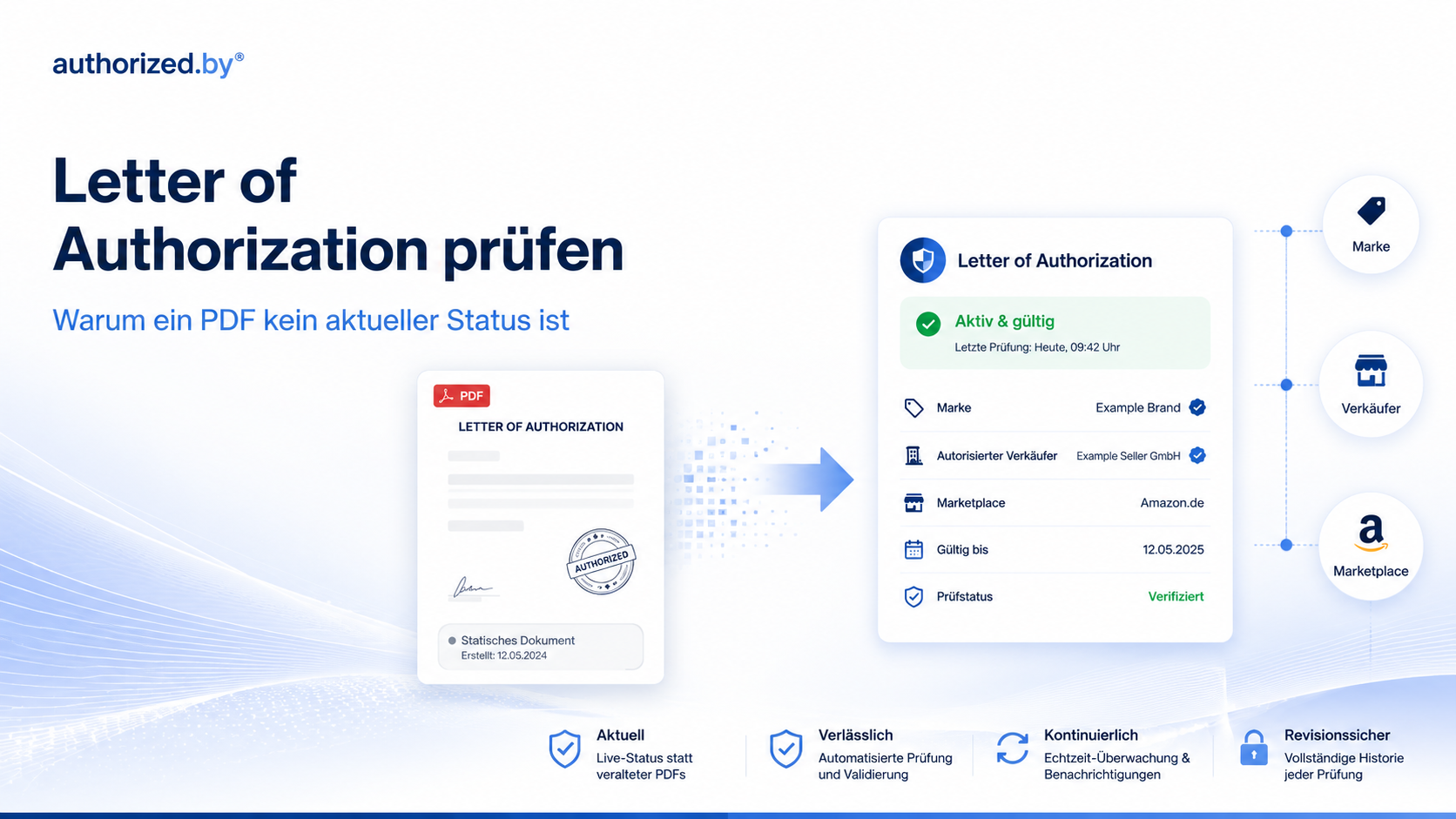
Verify a Letter of Authorization: Is a PDF Enough?
Online marketplaces regularly face the question of whether a retailer is actually entitled to offer products of a specific brand.
As proof, a Letter of Authorization, or LOA for short, is frequently submitted. This is usually a document in which a brand, a manufacturer, or a distribution partner confirms a business relationship with a retailer.
But how can a Letter of Authorization be verified reliably? What information must the document contain? And how can a marketplace tell whether the retailer authorization declared in it is still up to date?
A PDF can be an important basis for verification. However, it remains a snapshot whose validity depends heavily on its content, origin, scope, and currency.
What is a Letter of Authorization?
A Letter of Authorization is a written proof of authorization. It is meant to document that a company or retailer may sell certain products, brands, or services within a defined scope.
Depending on the brand, industry, and distribution model, such a letter can confirm different things:
- a general business relationship,
- the status as a retailer or distribution partner,
- permission to sell specific branded products,
- the use of brand materials,
- supply to a specific country,
- approval of a specific sales channel,
- selling via a specifically named marketplace.
There is no uniform, cross-industry format for Letters of Authorization. Documents therefore differ considerably in structure, content, and validity.
This is exactly what makes verifying them so labor-intensive for marketplaces.
Why do marketplaces require proof of authorization?
Marketplaces may request a Letter of Authorization, for example, when a retailer:
- offers products of a well-known or particularly protected brand,
- wants to have a new brand category unlocked,
- wants to appear as an official or authorized retailer,
- lists unusually large product quantities,
- has been reported by a brand or rights holder,
- is active in a high-risk product segment,
- wants an existing block or restriction to be reviewed.
The proof is meant to help the marketplace better assess the relationship between retailer and brand.
However, two questions need to be distinguished:
Who is the retailer?
And:
Has the brand actually confirmed this retailer for the specific sales activity?
KYC, KYB, and traditional seller verification processes focus primarily on the identity and company data of the seller. A Letter of Authorization, by contrast, is meant to document an additional relationship: the connection between brand and retailer.
What information should a Letter of Authorization contain?
For an authorization letter to be verified meaningfully, it should contain information that is as specific and clearly attributable as possible.
1. Complete details of the brand
The letter should make clear which company is granting the authorization.
Ideally, this includes:
- full company name,
- legal form,
- business address,
- business contact details,
- commercial register information where applicable,
- a clear link to the brand in question.
In the case of corporate groups, it should also be clear which company is entitled to grant the authorization.
A distribution company, agency, or subsidiary with the same name is not automatically entitled to authorize retailers on behalf of the brand owner for all markets and channels.
2. Unambiguous details of the retailer
The authorized retailer must also be identifiable beyond doubt.
Particularly relevant are:
- full company name,
- legal form,
- company address,
- shop domain,
- marketplace account or seller ID where applicable,
- country or sales territory.
A general trading name alone is often not enough to determine with certainty which company the confirmation refers to.
3. Naming of the brand concerned
The letter should state clearly which brand or brands the declaration applies to.
An existing business relationship with a manufacturer does not necessarily mean that the retailer may sell all of the company's brands, product lines, or sub-brands.
4. Scope of the authorization
One of the most important questions is:
What exactly was authorized?
The document should, as far as possible, specify whether the confirmation applies to:
- the entire product range,
- specific product groups,
- individual countries,
- selected regions,
- B2B or B2C sales,
- brick-and-mortar retail,
- the retailer's own online shop,
- a specific marketplace,
- several specifically named sales channels.
A general confirmation as a “business partner” or “customer” does not automatically answer the question of whether the retailer may sell the brand via a specific online marketplace.
5. Start and duration of the authorization
A reliable proof should include a date of issue.
In addition, it should be clear:
- since when the authorization has been valid,
- whether it is limited in time,
- when it ends,
- whether it can be renewed,
- whether it can be revoked at any time.
Without any temporal context, the marketplace can hardly assess whether the declaration is still current.
6. Name and role of the signing person
The signature should be attributable to a specific person.
Important details include:
- first and last name,
- position within the company,
- department,
- business email address,
- phone number where applicable.
It must also be assessed whether the person, given their position, can even be entitled to grant such a retailer authorization.
7. Traceable form of issuance
The document should ideally have been created on official letterhead or via a traceable digital process.
A logo and a signature alone, however, are not sufficient to establish authenticity and currency beyond doubt. Graphic elements can be copied, and digital documents can be modified after the fact.
How can a Letter of Authorization be verified?
The verification of an authorization letter should not rely solely on its outward appearance.
Cross-check company data
The details of the brand and the retailer should be cross-checked against reliable company information.
Points to verify include:
- Does the issuing company exist?
- Do the name, legal form, and address match?
- Does the stated domain actually belong to the company?
- Is the issuing company the owner or an authorized representative of the brand?
- Do the retailer details match the seller account?
Even minor discrepancies can indicate outdated data, an inaccurate attribution, or a proof that is not sufficiently reliable.
Verify sender and contact details
A confirmation sent from a freely available email address, or from a domain that merely resembles the official company domain, should be examined more closely.
However, even a seemingly correct sender address does not automatically prove that the signing person is entitled to grant the authorization.
Compare content with the requested approval
The content of the document must match the specific matter under review.
If, for example, an activation for a specific marketplace is requested, the Letter of Authorization should also show that this sales channel is covered by the confirmation.
A general supply relationship, or the right to sell via the retailer's own online shop, is not automatically equivalent to an approval for every marketplace.
Check the date of issue and expiry date
A letter that is several years old can be formally genuine and yet no longer reflect the current state of the business relationship.
The following should therefore be checked:
- When was the document issued?
- Is there a defined expiry date?
- Has the company structure changed since then?
- Does the business relationship still exist?
- Has the sales channel in question been restricted in the meantime?
- Has the brand revoked the authorization?
Obtain direct confirmation from the brand
The most reliable form of verification is a current confirmation from the brand itself.
It should refer to the specific combination of retailer, brand, and sales channel.
This not only establishes whether the document was originally genuine. It also clarifies whether the authorization declared in it still exists today.
Why is a genuine document not automatically a current proof?
When verifying Letters of Authorization, two different questions are often mixed up:
- Is the document genuine?
- Is the information it contains still current?
A document can be genuine and still reflect an outdated state of affairs.
Since it was issued, many things may have changed:
- The business relationship has been terminated.
- The retailer is no longer being supplied.
- Certain product groups have been excluded.
- The brand has blocked individual sales channels.
- The retailer may still sell in-store, but no longer online.
- The approval does not apply to the marketplace in question.
- The brand owner or the distribution structure has changed.
- The company that originally signed is no longer responsible.
A Letter of Authorization therefore initially proves that a declaration was made at a certain point in time.
Whether the same declaration still applies today must be clarified separately.
The sales channel is a decisive element
A retailer authorization is not always valid across all sales channels.
Brands may, for example, authorize their partners differently for:
- brick-and-mortar specialist retail,
- the retailer's own online shop,
- B2B sales,
- specific platforms,
- individual countries,
- cross-border sales,
- selected product categories.
For a marketplace, it is therefore not always enough to ask:
Is there a relationship between brand and retailer at all?
The more precise question is:
Has the brand also confirmed this retailer for the specific sales channel in question?
If this information is missing, the decisive part of the authorization check remains open.
Typical warning signs in authorization letters
A single warning sign does not prove manipulation or a lack of entitlement. However, several anomalies should lead to a more in-depth review.
These include:
- missing date of issue,
- no expiry date on a very old document,
- incomplete details of the issuing company,
- private or unusual email address,
- unclear position of the signing person,
- no mention of the retailer's legal entity,
- no clear shop domain or seller ID,
- inconsistent spellings of company names,
- no mention of the brand concerned,
- very general wording,
- no statement on the sales channel,
- content that appears to have been inserted afterwards,
- noticeable differences in formatting,
- poorly resolved logos or signatures,
- a document that is used identically for several different retailers.
Even with inconspicuous documents, a current reconfirmation by the brand remains the more reliable basis.
What challenges arise with manual verification processes?
Manual LOA checks cause considerable effort in larger retailer and brand networks.
Each document must individually be:
- received,
- opened,
- read,
- assigned to the correct retailer,
- assigned to the correct brand,
- checked for formal anomalies,
- evaluated in terms of content,
- documented,
- given an expiry date,
- re-checked at a later point in time.
Added to this are follow-up questions to retailers and brands, different languages, various document formats, and missing or contradictory information.
As the number of sellers, brands, and listings grows, this effort increases accordingly.
Particularly problematic: a document that has been checked once does not automatically report when the underlying retailer relationship ends later on.
What information does a marketplace really need?
For automated marketplace processes, the document itself is not the most important piece of information.
What is needed is an unambiguous answer to a clearly defined request:
- Which brand is concerned?
- Which retailer is concerned?
- Which sales channel is concerned?
- Is there a confirmed authorization?
- Who confirmed it?
- When was it last verified?
- Is it currently active?
- Has the status changed?
A structured status can be processed directly within a system.
Depending on the result, the marketplace can then, for example:
- activate the retailer,
- request additional documents,
- start a review process,
- contact the brand,
- put the listing on hold,
- escalate the case to risk or compliance.
This turns an unstructured file into a technically usable basis for decisions.
From document verification to a current authorization status
A digital authorization check does not necessarily replace every document-based proof.
It does, however, change the perspective:
The focus is no longer on the uploaded PDF, but on the currently confirmed relationship between brand and retailer.
Such a process should:
- clearly match brand, retailer, and sales channel,
- record existing confirmations in a structured way,
- request missing confirmations from the brand,
- document the result in a traceable manner,
- take changes in the business relationship into account,
- provide the status in machine-readable form.
This is exactly where Authorization as a Service by authorized.by® comes in.
The marketplace submits the relevant retailer, brand, and channel information. If a confirmed authorization already exists, the current status can be provided. Otherwise, a structured process with the brand can be initiated.
The brand confirms the business relationship. authorized.by® verifies and documents the process and provides the marketplace with an unambiguous, machine-readable authorization status. If the authorization changes, the provided status is updated as well.
Discover Authorization as a Service for marketplaces →
Seller verification and brand authorization complement each other
Verifying a retailer authorization does not replace identity or company verification.
Seller verification, KYC, and KYB primarily answer:
Who is the retailer?
Brand authorization adds a further relationship to this information:
Has the brand confirmed this retailer for the sales activity in question?
For marketplaces, this creates two distinct but interconnected verification layers:
- the identity and economic existence of the retailer,
- the sales relationship confirmed by the brand.
authorized.by® complements existing seller verification and compliance processes with structured proof of this brand-retailer relationship.
Context within the Digital Services Act
Article 30 of the Digital Services Act contains requirements on the traceability of traders for online platforms in scope that allow consumers to conclude distance contracts with traders.
These include collecting certain trader details as well as making reasonable efforts to assess the reliability and completeness of this information.
The DSA therefore does not automatically require a Letter of Authorization or a confirmation from the brand for every branded product.
Furthermore, a brand authorization is not equivalent to the legally required trader identification.
However, it can complement existing verification, risk, and documentation processes with an additional piece of information: the relationship with a specific retailer as confirmed by the brand.
Authorization as a Service is not a DSA certification and replaces neither a legal review nor the compliance responsibility of a marketplace.
Frequently asked questions about verifying a Letter of Authorization
Is a Letter of Authorization required by law?
There is no general legal obligation to provide a Letter of Authorization for every branded product offered on a marketplace.
However, marketplaces may require such proof as part of their own retailer, risk, brand, or activation processes.
Who may issue a Letter of Authorization?
The letter should come from the brand owner or from a company or person that is demonstrably entitled to confirm the retailer and sales relationship in question.
How long is a Letter of Authorization valid?
That depends on the content of the document.
If the letter contains an expiry date, its formal validity ends at that point. If there is no expiry date, this does not automatically mean that the business relationship continues indefinitely.
The current authorization should therefore be verified independently of the document.
Is a signature from the brand sufficient?
A signature can improve traceability. However, it does not automatically confirm that the signing person was entitled to sign or that the declaration is still current.
Does the marketplace have to be named explicitly?
Not every authorization letter necessarily names a specific marketplace.
For a channel-specific approval, however, an explicit mention or a separate confirmation is considerably more reliable than a general statement about a business relationship.
Can a distributor authorize a retailer?
That depends on the distributor's rights.
A distributor can only provide a reliable confirmation on behalf of a brand if it is itself entitled to grant or confirm the corresponding distribution rights.
What happens if the brand does not respond?
A lack of response should not automatically be interpreted as a rejection.
In this case, the status should be treated as open, pending, or not confirmed. What consequences follow from this is decided by the marketplace within its own review processes.
Is a missing authorization status proof of an untrustworthy retailer?
No.
A missing status can mean, for example, that no request has been made yet, that the brand does not work with a formal authorization model, or that the process has not yet been completed.
The status is a basis for decisions, but not a blanket assessment of the entire company.
Can the verification be automated?
An uploaded PDF can be read and formally analyzed by technical means.
The decisive substantive question – whether the brand currently confirms the retailer for the channel in question – can only be answered through a reliable authorization source or a corresponding verification process.
Conclusion: A document proves a declaration – a status reflects the current relationship
A Letter of Authorization can be an important part of retailer verification.
Its validity, however, depends on whether the brand, retailer, product scope, period of validity, and sales channel are clearly named, and whether the declaration it contains still reflects the current state.
Verification should therefore not end with the formal authenticity of the document.
For marketplaces, a different piece of information is ultimately decisive:
Is this retailer confirmed by this brand today for the requested sales channel?
A structured authorization status makes this answer traceable and usable for digital processes.
Discover digital brand authorization for marketplaces →
Discuss the authorization process with authorized.by® →
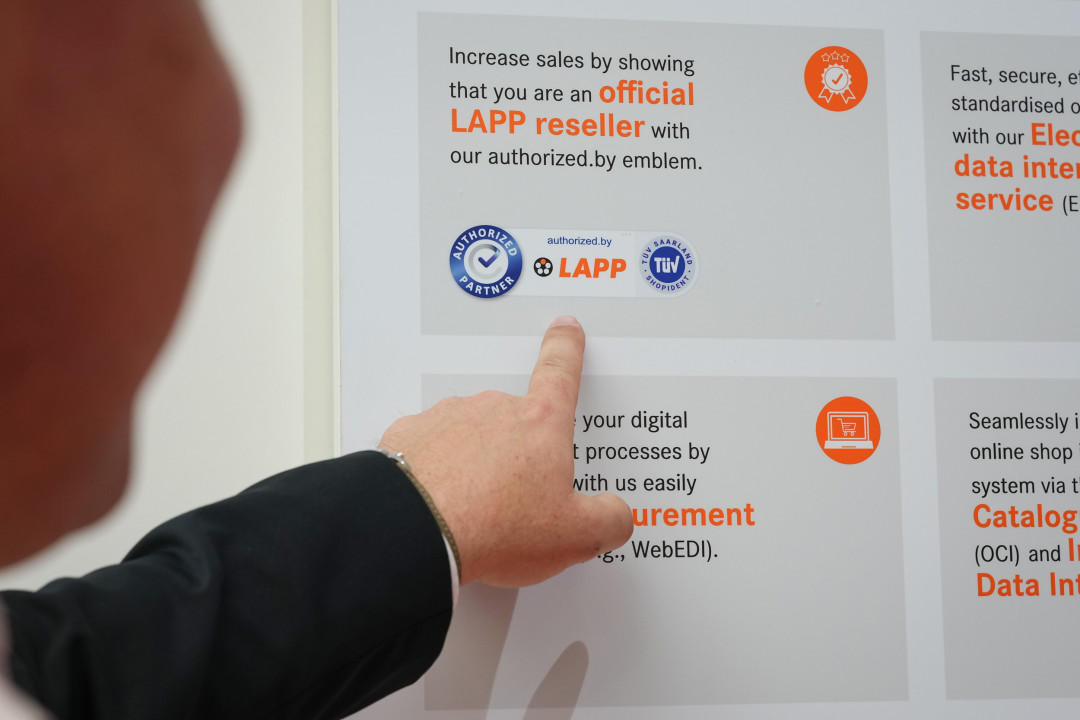
Lapp Partners with authorized.by: A Strong Brand Strengthens Trust in B2B Distribution
A strong signal for transparency in industrial B2B commerce: Lapp Group, one of the world's leading providers of cables and connection technology, is making its verified authorized.by seal available to its official distributors. This makes the official dealer authorization visible, verifiable, and tamper-proof in the digital sales channel — and another globally operating industrial brand is showing what structured distributor management looks like in the digital age.
Trust in Industrial Procurement: A Growing Challenge
In globalized and digitalized markets, buyers face an increasingly complex task: reliably identifying verified sources of supply. Particularly in technically demanding applications — such as cables and connection technology — unauthorized providers or counterfeit products can lead to serious quality and liability consequences.
Lapp addresses this challenge with a concrete digital signal: the verified online seal from authorized.by.
The Seal: Real-Time Verification Directly in the Online Shop
The authorized.by seal can be integrated directly into websites, marketplaces, and online shops. With a single click, a centrally managed, tamper-proof database verifies in real time whether a given provider is officially part of Lapp's distribution network. The verification is available to both buyers and the distributors themselves — no interruption, no back-and-forth, no doubt.
Manuel Richter, Head of Digital Business Development Component Sales EMEA at Lapp:
"In technically demanding applications, quality, authenticity, and traceability are critical. By using the authorized.by seal, we create a new form of digital security for our customers. They can immediately see whether a provider is part of our authorized network."
Stefanie Gutscher, Digital Sales Project Manager at Lapp, adds:
"We are very proud to offer our distributors a service that gives their own customers more transparency, visibility, and security in the digital environment."
What the Seal Means for Buyers
For procurement professionals in industrial environments, the seal brings a significant simplification to everyday work:
- Authorized distribution partners are immediately recognizable
- Verification is simple, fast, and available at any time
- The risk of inadvertently purchasing from unauthorized providers or receiving counterfeit products is minimized
- Product traceability becomes transparent, efficient, and secure
What the Seal Means for Distributors
Authorized Lapp distributors benefit directly as well:
- The official brand partnership becomes digitally visible and verifiable
- Credibility and competitive positioning strengthen in an increasingly digital market
- Discoverability in digital search and comparison processes improves
- Long-term customer loyalty is reinforced by a clear trust signal
What It Means for authorized.by: Strong Brands Strengthen the Ecosystem
The partnership with Lapp is further evidence of the growing relevance of authorized.by in industrial B2B commerce. Following its inclusion as a trust signal in the Verbraucherzentrale's Fakeshop-Finder on the B2C side, the collaboration with a brand like Lapp demonstrates: the principle of verified dealer authorization works across industries — and gains particular strength wherever technical quality, product authenticity, and supply chain security are business-critical.
"Our goal is to make trust in the digital space measurable and visible. The partnership with Lapp Group shows how much potential lies in structured, data-driven distributor management. Together, we are creating real value for B2B e-commerce."
— Felix Nottensteiner, CEO of authorized.by
Lapp and authorized.by: A Partnership That Sets a Precedent
Lapp is a globally active manufacturer of cables, wires, and connection systems with operations in over 100 countries — a benchmark setter in its industry. The fact that a brand of this strength and technical reputation relies on the authorized.by seal powerfully confirms the relevance of the approach: verified dealer authorization is being recognized as strategically significant by leading industrial companies.
Digital dealer authorization is not a nice-to-have — it is a strategic cornerstone of modern distribution architecture.
authorized.by is part of the TÜV Saarland Group and provides brands and dealers with the infrastructure to make verified distribution relationships digitally visible — in real time, tamper-proof, and at scale.
Authorization in the Age of AI: When Agents Do the Buying
The relevance of verified dealer authorization is growing for yet another reason — one that is fundamentally reshaping the future of B2B commerce.
AI models and autonomous agents are increasingly taking over tasks in the procurement process: researching suppliers, comparing offers, evaluating sources — and making or preparing purchasing decisions. The customers of the future are no longer exclusively human; they are also systems acting on behalf of humans.
For these systems to reliably distinguish between authorized and unauthorized dealers, they need machine-readable, structured trust signals. That is precisely what authorized.by delivers: authorization data is accessible via a public API, interpretable by LLM models and AI agents, and integratable into digital procurement workflows.
At the same time, AI opens new avenues for counterfeiting, fake dealer profiles, and manipulated search results — risks that conventional manual verification processes can barely contain. A centrally managed, tamper-proof authorization database that can be queried in real time thus becomes core infrastructure for secure digital commerce — for human buyers and the AI systems that support or replace them alike.
By integrating the authorized.by seal, Lapp is not only making a statement for today — it is positioning its distribution network for the demands of an AI-driven procurement landscape tomorrow.
More Transparency. More Security. More Trust.
The collaboration with Lapp shows what becomes possible when brand authorization is consistently thought through digitally: buyers gain security, distributors gain visibility, brands gain control.
authorized.by makes exactly that measurable — and with Lapp, now also in industrial B2B commerce.
More information about the platform and seal integration at authorized.by.
Press coverage of the partnership: elektro.net · materialfluss.de
Giant: TÜV-Siegel für autorisierte Shops
Um Verbraucher vor Fake-Shops und gefälschten Produkten zu schützen, setzt Fahrradproduzent Giant jetzt authorized.by vom TÜV Saarland ein.
Webshops von Händlern, die für den Vertrieb von Giant-Produkten autorisiert wurden, bekommen das Siegel »Authorized Partner mit TÜV-ShopIdent«. Die Webshops der Giant-Stores sowie der markeneigene Webshop tragen das Siegel »The Official Brand Shop mit TÜV- ShopIdent«.

Giant kündigt Online-Siegel für Handelspartner an
Der Fahrradhersteller Giant Deutschland schützt bald den Online-Auftritt seiner Marken und Vertriebspartner mit einem Online-Siegel vor Fälschungen.
Fahrräder und Zubehör sind mittlerweile ein stark wachsender Konsumbereich geworden, was auch zu Fälschungen und Betrug führt. Davor möchte Giant sich und seine Vertriebspartner durch die Zusammenarbeit mit authorized.by schützen. Aus diesem Grund erhalten händlereigene Webshops, die für den Vertrieb von Giant-Produkten autorisiert wurden, das Siegel „Authorized Partner mit TÜV-ShopIdent“ und die Webshops der Giant Stores als auch der markeneigene Webshop das Siegel „The Official Brand Shop mit TÜV-Shopident“.

Mehr Sicherheit für Marken auf Amazon über authorized.by
Die Autorisierungsplattform authorized.by bietet für Marken ab sofort eine direkte Schnittstelle zur Amazon Brand Registry an. Das Echtzeitsiegel soll dabei helfen, Marken aufzubauen und zu schützen.

Wie Online-Shops mit Markenautorisierungen das Verbraucher-Vertrauen gewinnen
Vor allem unbekanntere Webshops haben häufig unter einem Vertrauensproblem zu leiden. Felix Nottensteiner, CEO und Gründer von authorized․by zeigt anhand von Beispielen, wie Siegel für autorisierte Marken-Shops Verbraucher-Vertrauen und Conversion steigern können.
So will Keen den Fachhandel noch besser unterstützen
Der Outdoor-Schuhspezialist Keen holt sich drei neue Partner an Bord, um den Service für seine Handelspartner in Deutschland noch weiter auszubauen.
Für Keen, US-amerikanischer Hersteller von Outdoor-Schuhen (Portland), ist Deutschland der größte und dynamischste Markt. Aus diesem Grund hat die Schuhmarke erst vor Kurzem sein Vertriebsteam neu aufgestellt. Nun ergreift man weitere Maßnahmen, um für den Einzelhandel die Geschäftsbeziehungen noch attraktiver zu gestalten: Dazu wurden drei neue Partnerschaften mit SocialPals, Myagi und dem Gütesiegel „Authorized Partner“ bekannt gegeben.
Start-ups und der TÜV
Was auf den ersten Blick vielleicht wie ein etwas merkwürdiger Witz klingen mag: „Trifft sich ein Start-up mit dem TÜV …“, ist auf den zweiten Blick weitaus sinnvoller als vielleicht angenommen. Fünf erfolgreiche Start-up‘ler aus verschiedenen Branchen beschreiben ihre Erfahrungen mit dem TÜV und warum sie mit ihm kooperieren.