Authorization in the Age of AI: Why Trust Must Become Machine-Readable
The way people search for, compare and purchase products is undergoing a fundamental transformation.
For many years, a purchasing decision usually began with a search engine. Consumers entered a product name, opened several results, compared prices, read reviews and then decided for themselves which retailer they trusted.
Today, a growing share of this research is moving into AI systems and large language models.
Users are no longer simply asking:
“Where can I buy this product?”
Instead, they formulate complete requirements:
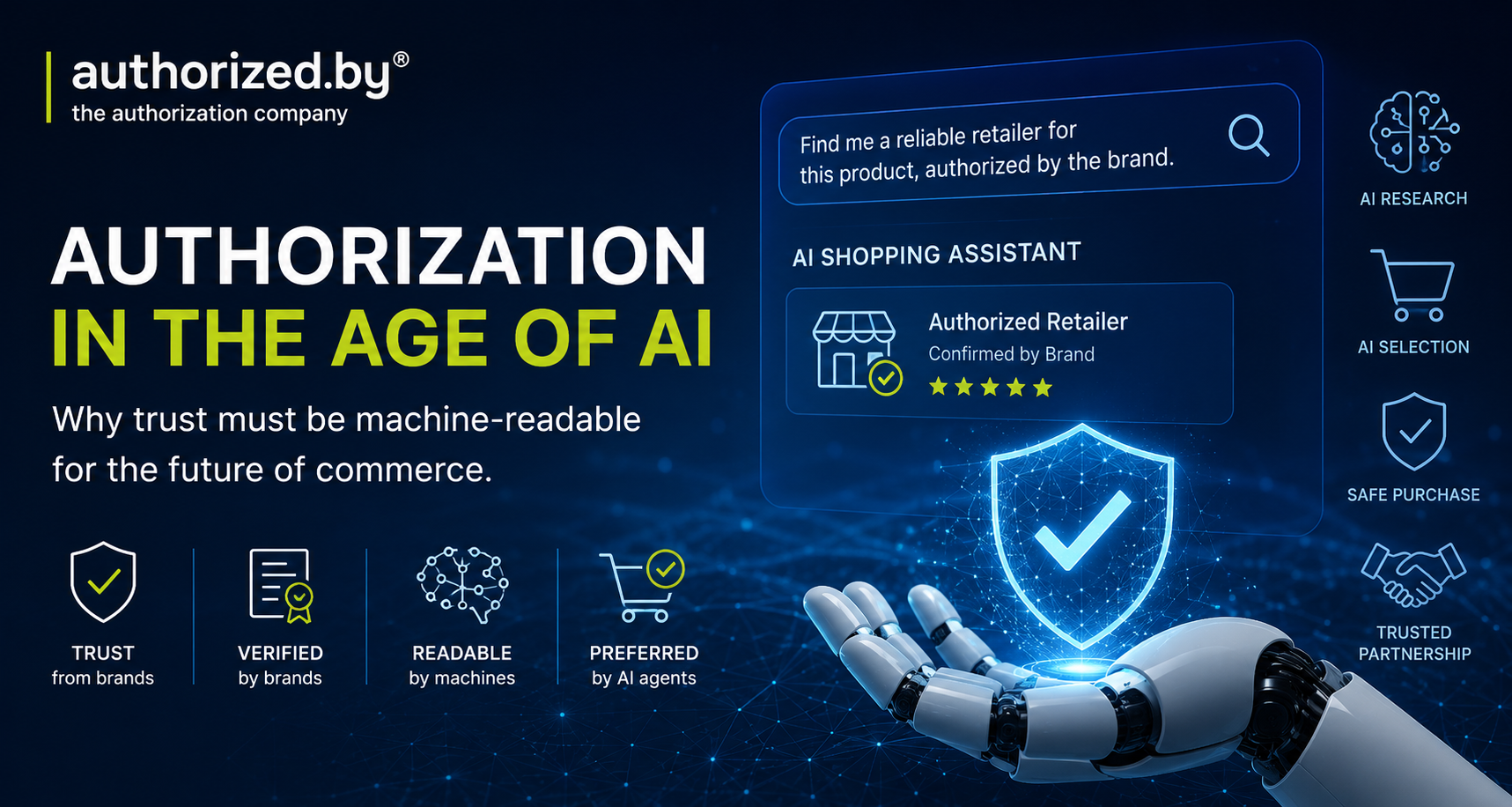
“Find me a reliable retailer for this product that delivers to Germany, offers a good price and is officially authorized by the manufacturer.”
The AI system increasingly takes over tasks that consumers previously performed themselves. It researches, compares, evaluates sources and reduces a large number of possible offers to a small selection of recommendations.
This development will not stop at research. AI systems will increasingly select products, prepare shopping carts and support or complete purchases on behalf of their users.
Shopping through AI agents is therefore developing from a future scenario into a new part of digital commerce infrastructure.
From search engines to personal shopping agents
A search engine provides links. An AI assistant increasingly provides a specific answer.
This difference is significant.
With a traditional Google search, users decide for themselves which results to open, which providers to investigate and where they ultimately want to buy. An AI system, however, can make several preliminary decisions before the user ever visits a shop:
- Which products match the request?
- Which retailers qualify as potential sources?
- Which sources appear reliable?
- Which offers are mentioned at all?
- Which providers are excluded?
- Which retailer should fulfil the purchase?
The next stage of development is already foreseeable. People define an objective, a budget and certain requirements. The AI agent performs the research, evaluates the providers and may also complete the order.
The retailer will then no longer compete only for the attention of a person.
The retailer will compete to be recognized by an AI system as a suitable and trustworthy source.
Trust will become a decisive success factor
The success of a search engine was never based solely on indexing as many websites as possible.
The quality of the results was decisive.
People used Google because they trusted that the first results would provide relevant answers. The more reliable those results appeared, the more frequently the search engine was used.
A similar principle applies to AI systems, but with even greater consequences.
An AI assistant that merely recommends information can be corrected. A shopping agent that selects products, processes personal data or initiates an order on behalf of a person carries significantly more responsibility.
For people to use these systems permanently, the results must not only be convenient. They must also be:
- relevant,
- transparent,
- safe,
- up to date and
- trustworthy.
Trust is therefore considered a fundamental requirement for the broad adoption of AI and agentic systems. This is particularly true when AI no longer simply provides information but prepares or executes decisions independently.
This creates a new question for digital commerce:
Which information can an AI system rely on when assessing a retailer?
A professional-looking shop is not necessarily a trustworthy retailer
In traditional ecommerce, trust has often been communicated visually.
A professional design, high-quality product images, familiar payment methods, customer reviews, trust seals and a convincing brand experience are intended to signal to consumers:
“You can shop safely here.”
These elements remain important as long as a person visits the shop and makes the decision.
However, an attractive website is not reliable evidence of an official business relationship between a brand and a retailer.
With modern shop systems, templates and generative AI, almost any provider can create a professional-looking online shop within a short period of time. Unauthorized retailers, grey-market sellers and fraudulent shops can also appear visually convincing.
The appearance of a shop therefore does not answer the decisive question:
Has this retailer actually been confirmed by the relevant brand as an authorized retail partner?
authorized.by® makes precisely this relationship visible. Authorization is granted by the brand. The retailer cannot assign or independently change its own status.
If the brand revokes or ends an authorization, the publicly verifiable status also changes.
What people see and what machines understand
A person often recognizes a trust signal visually:
- a seal,
- a certificate,
- a brand logo,
- a positive review,
- a professional design.
An AI system also requires structured and clearly attributable information.
It must be able to identify technically:
- Which retailer is being referred to?
- Which brand confirmed the retailer?
- Which domain is covered by the authorization?
- Is the partnership currently active?
- When was the status last updated?
- Where can the reference source be found?
- Can the information be independently verified?
- Does the statement come from the retailer itself or from the brand?
This changes the value of digital trust signals.
A visible seal remains relevant to people. For AI systems, however, the information behind the seal becomes increasingly important.
It is not enough for the visual representation to be available. The underlying statement must also be accessible:
This brand currently confirms this retailer as an authorized retail partner.
Why authorization is a distinctive trust signal
A great deal of the information about an online shop comes from the retailer itself.
The retailer describes its company, maintains its product data, formulates its service promises and decides which awards or seals to display on its website.
A brand authorization is fundamentally different.
It is not a self-declaration by the retailer.
It is the documented statement of another business party: the brand.
Authorization therefore describes a real relationship between two companies:
- the brand as the confirming party and
- the retailer as the authorized retail partner.
For an AI system, the origin of this information is crucial.
The statement “We are an official retailer” is initially a claim made by the shop.
The statement “The brand confirms this retailer” is information that can be verified through an external source.
This is precisely what can make authorization a valuable signal when assessing a provider.
Authorization does not automatically mean that every offer is the cheapest or that every transaction will proceed without problems. It does, however, document that the retailer is part of a distribution relationship confirmed by the brand.
Price will remain important, but safety will become a selection criterion
Price will remain an important factor in AI-supported purchasing.
However, the lowest price is not automatically the best result.
An AI agent may also need to consider:
- Is the provider a real company that can be legally contacted?
- Is there an official relationship with the brand?
- Does the offer come through a regular distribution channel?
- Has the retailer been confirmed for the relevant sales channel?
- Is the underlying information current?
- Can the source be verified technically?
- Are there indications of grey-market or counterfeit risks?
- Can the status be traced in the event of a later complaint?
A good purchasing result is therefore not necessarily the cheapest offer.
It is the offer that combines price, availability, service, safety and trustworthiness in a meaningful way.
The more AI systems participate in purchasing decisions, the more important clearly referencable security and trust information will become.
From visible signals to referencable facts
In traditional ecommerce, retailers primarily had to be convincing to people.
In AI-driven commerce, they must also become understandable to machines.
This does not mean that shop design, branding or user experience will become irrelevant. Once a customer visits the shop, these factors will remain important for conversion.
Their role will, however, change.
If an AI agent decides which retailers qualify before the user ever visits a shop, visual trust signals only begin to have an effect after a technical preselection has already taken place.
A referencable authorization can potentially be considered during that preselection.
A digital authorization is:
- clearly attributable to a specific brand and retailer,
- confirmed by the brand,
- available as a current status,
- digitally verifiable,
- referencable as a source and
- available in machine-readable form.
This transforms a visual trust signal into digital information that can also be processed outside the retailer’s shop.
Machine-readable authorizations at authorized.by®
authorized.by® does not only display confirmed brand-retailer relationships through real-time seals, the public directory and digital certificates.
Current authorization information is also made available in machine-readable form through technical interfaces and MCP infrastructure.
This allows search engines, marketplaces, large language models and AI agents to technically retrieve the confirmed relationship between a brand and a retailer and reference it as a source.
The digital retailer and partnership certificates also create publicly accessible reference points.
An AI system can therefore potentially retrieve information about:
- which brand confirmed the retailer,
- which current status applies,
- which domain the authorization belongs to and
- whether the relationship remains active.
Further information about the technical provision of authorization data can be found in the authorized.by® FAQ.
This does not guarantee that a particular AI system will include, mention or preferentially recommend a retailer.
However, authorization creates a structured data foundation that automated systems can potentially consider as an additional trust signal.
Participation is free for retailers
Basic participation in authorized.by® is free for online retailers.
Retailers can create a profile, ask their partner brands for confirmation and request authorizations. Once a brand confirms the partnership, the relationship becomes visible in the retailer profile, the corresponding certificate and the “Ask the Brand” directory.
The machine-readable provision of confirmed authorization information is also part of this network.
Paid services add further functions, visibility options and services to the free participation model.
Access is deliberately designed to be straightforward:
Every retailer should have the opportunity to have genuine brand relationships officially confirmed and made digitally verifiable.
Register with authorized.by® for free
Why retailers should act now
Agentic commerce is still at an early stage of development.
However, the underlying technical infrastructure is already being created.
Products, providers, retailer data and trust information will increasingly need to be available in structured and machine-readable form.
Retailers should therefore not wait until AI agents already influence a significant proportion of purchasing decisions.
The essential foundations can be established today:
- Keep company data up to date.
- Clearly associate the relevant shop domain with the company.
- Have brand partnerships confirmed.
- Build digital certificates as reference sources.
- Provide structured product information.
- Enable technical accessibility for AI systems.
- Make trust signals not only visible but also verifiable.
Will authorization become an entry ticket to the digital value chain?
Today, a confirmed retailer authorization is an additional trust signal.
In the future, it may become significantly more important.
If AI agents independently select providers, they will require criteria that allow them to distinguish trustworthy sources from unknown or unconfirmed retailers.
A machine-readable brand authorization offers a distinctive quality:
It comes directly from the brand, can be assigned to a specific retailer and can be checked as a current status.
It is therefore conceivable that verifiable brand-retailer relationships will increasingly influence different processes:
- the selection of sources by AI shopping agents,
- recommendations made by AI assistants,
- retailer verification on marketplaces,
- automated risk and compliance processes,
- search and information systems,
- digital procurement processes,
- the preselection of official retail partners.
Authorization may therefore gradually develop from a visible shop signal into an entry ticket to the digital value chain.
Not because every AI system will necessarily favour authorized retailers.
But because systems can only take information into account if that information is digitally available, clearly attributable and technically accessible.
Retailers that do not document their trustworthiness in a machine-readable form risk becoming invisible or impossible to assess reliably for automated systems.
Brands also have a responsibility
This development does not only affect retailers.
Brands decide which partners belong to their official distribution network. They therefore hold information that is becoming increasingly valuable to consumers, marketplaces and AI systems.
By digitally authorizing their retail partners, brands can:
- make their official retailers clearly visible,
- distinguish unauthorized providers more clearly,
- show consumers safer sources of supply,
- strengthen trusted partners in digital competition,
- represent their distribution structure in machine-readable form,
- provide AI systems with a verifiable source,
- document changes and revocations as current status information.
The brand therefore becomes the authoritative source for determining which retailer is actually part of its official network.
Learn more about retailer authorization for brands
Trust requires a verifiable origin
In the age of AI, the decisive question will not only be which information is available.
It will also be where that information comes from.
- A product description usually comes from the retailer or manufacturer.
- A review comes from a customer or platform.
- An identity check confirms the company behind a shop.
- A retailer authorization comes from the brand and documents the business relationship with its retail partner.
Only the combination of such sources enables a robust assessment.
For AI systems, provenance – the traceable origin of information – will therefore become a significant quality criterion.
Trust is not created by the sheer volume of data. It is created by current, verifiable and clearly attributable information.
Conclusion: Trust must be visible to people and readable by machines
Digital commerce is facing a fundamental transformation.
Product research is increasingly moving from traditional search engines to AI assistants. The next step will involve agents that compare products, select providers and complete purchases on behalf of their users.
This also changes the role of trust.
A professional shop, a competitive price and a visible seal will remain important. However, they are not sufficient when an automated system needs to determine which provider is a trustworthy source.
That requires referencable facts.
A retailer authorization confirmed by the brand is such a fact.
authorized.by® makes this relationship visible, verifiable and machine-readable for consumers, search engines, marketplaces, large language models and AI agents.
Participation is free for retailers. Every confirmed authorization expands the digital data foundation that automated systems can potentially use.
A recommendation by a particular AI system cannot be guaranteed.
However, one point is clear:
Information that is not digitally documented, referencable and machine-readable is difficult for AI systems to consider reliably.
Authorization is therefore becoming an important building block for trust in AI-driven commerce – and potentially a future entry ticket to the digital value chain.
Register with authorized.by® for free
Explore “Ask the Brand” and the official directory
Discover Authorization as a Service for marketplaces
Further reading and sources