
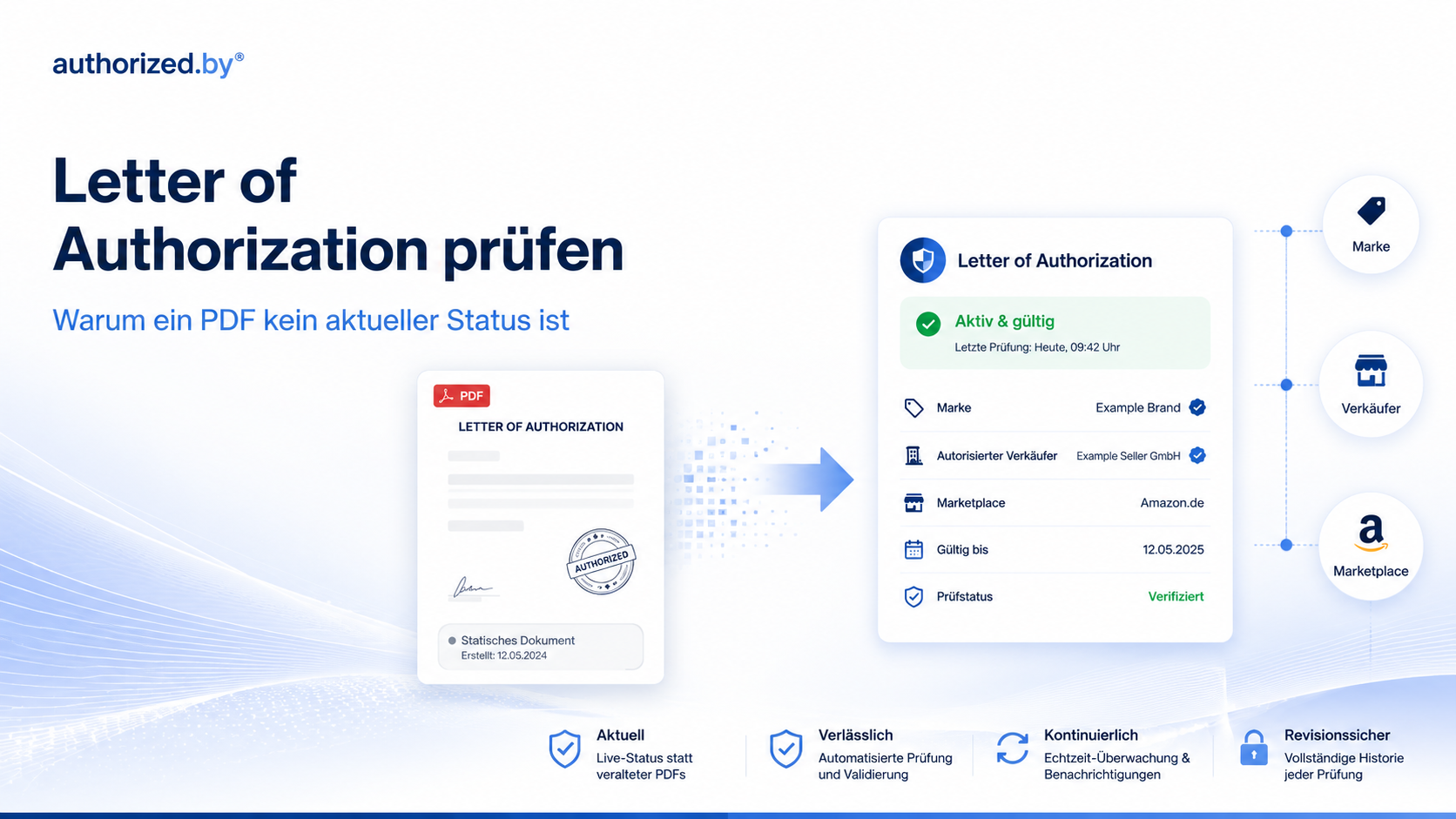
Verify a Letter of Authorization: Is a PDF Enough?
Online marketplaces regularly face the question of whether a retailer is actually entitled to offer products of a specific brand.
As proof, a Letter of Authorization, or LOA for short, is frequently submitted. This is usually a document in which a brand, a manufacturer, or a distribution partner confirms a business relationship with a retailer.
But how can a Letter of Authorization be verified reliably? What information must the document contain? And how can a marketplace tell whether the retailer authorization declared in it is still up to date?
A PDF can be an important basis for verification. However, it remains a snapshot whose validity depends heavily on its content, origin, scope, and currency.
What is a Letter of Authorization?
A Letter of Authorization is a written proof of authorization. It is meant to document that a company or retailer may sell certain products, brands, or services within a defined scope.
Depending on the brand, industry, and distribution model, such a letter can confirm different things:
- a general business relationship,
- the status as a retailer or distribution partner,
- permission to sell specific branded products,
- the use of brand materials,
- supply to a specific country,
- approval of a specific sales channel,
- selling via a specifically named marketplace.
There is no uniform, cross-industry format for Letters of Authorization. Documents therefore differ considerably in structure, content, and validity.
This is exactly what makes verifying them so labor-intensive for marketplaces.
Why do marketplaces require proof of authorization?
Marketplaces may request a Letter of Authorization, for example, when a retailer:
- offers products of a well-known or particularly protected brand,
- wants to have a new brand category unlocked,
- wants to appear as an official or authorized retailer,
- lists unusually large product quantities,
- has been reported by a brand or rights holder,
- is active in a high-risk product segment,
- wants an existing block or restriction to be reviewed.
The proof is meant to help the marketplace better assess the relationship between retailer and brand.
However, two questions need to be distinguished:
Who is the retailer?
And:
Has the brand actually confirmed this retailer for the specific sales activity?
KYC, KYB, and traditional seller verification processes focus primarily on the identity and company data of the seller. A Letter of Authorization, by contrast, is meant to document an additional relationship: the connection between brand and retailer.
What information should a Letter of Authorization contain?
For an authorization letter to be verified meaningfully, it should contain information that is as specific and clearly attributable as possible.
1. Complete details of the brand
The letter should make clear which company is granting the authorization.
Ideally, this includes:
- full company name,
- legal form,
- business address,
- business contact details,
- commercial register information where applicable,
- a clear link to the brand in question.
In the case of corporate groups, it should also be clear which company is entitled to grant the authorization.
A distribution company, agency, or subsidiary with the same name is not automatically entitled to authorize retailers on behalf of the brand owner for all markets and channels.
2. Unambiguous details of the retailer
The authorized retailer must also be identifiable beyond doubt.
Particularly relevant are:
- full company name,
- legal form,
- company address,
- shop domain,
- marketplace account or seller ID where applicable,
- country or sales territory.
A general trading name alone is often not enough to determine with certainty which company the confirmation refers to.
3. Naming of the brand concerned
The letter should state clearly which brand or brands the declaration applies to.
An existing business relationship with a manufacturer does not necessarily mean that the retailer may sell all of the company’s brands, product lines, or sub-brands.
4. Scope of the authorization
One of the most important questions is:
What exactly was authorized?
The document should, as far as possible, specify whether the confirmation applies to:
- the entire product range,
- specific product groups,
- individual countries,
- selected regions,
- B2B or B2C sales,
- brick-and-mortar retail,
- the retailer’s own online shop,
- a specific marketplace,
- several specifically named sales channels.
A general confirmation as a “business partner” or “customer” does not automatically answer the question of whether the retailer may sell the brand via a specific online marketplace.
5. Start and duration of the authorization
A reliable proof should include a date of issue.
In addition, it should be clear:
- since when the authorization has been valid,
- whether it is limited in time,
- when it ends,
- whether it can be renewed,
- whether it can be revoked at any time.
Without any temporal context, the marketplace can hardly assess whether the declaration is still current.
6. Name and role of the signing person
The signature should be attributable to a specific person.
Important details include:
- first and last name,
- position within the company,
- department,
- business email address,
- phone number where applicable.
It must also be assessed whether the person, given their position, can even be entitled to grant such a retailer authorization.
7. Traceable form of issuance
The document should ideally have been created on official letterhead or via a traceable digital process.
A logo and a signature alone, however, are not sufficient to establish authenticity and currency beyond doubt. Graphic elements can be copied, and digital documents can be modified after the fact.
How can a Letter of Authorization be verified?
The verification of an authorization letter should not rely solely on its outward appearance.
Cross-check company data
The details of the brand and the retailer should be cross-checked against reliable company information.
Points to verify include:
- Does the issuing company exist?
- Do the name, legal form, and address match?
- Does the stated domain actually belong to the company?
- Is the issuing company the owner or an authorized representative of the brand?
- Do the retailer details match the seller account?
Even minor discrepancies can indicate outdated data, an inaccurate attribution, or a proof that is not sufficiently reliable.
Verify sender and contact details
A confirmation sent from a freely available email address, or from a domain that merely resembles the official company domain, should be examined more closely.
However, even a seemingly correct sender address does not automatically prove that the signing person is entitled to grant the authorization.
Compare content with the requested approval
The content of the document must match the specific matter under review.
If, for example, an activation for a specific marketplace is requested, the Letter of Authorization should also show that this sales channel is covered by the confirmation.
A general supply relationship, or the right to sell via the retailer’s own online shop, is not automatically equivalent to an approval for every marketplace.
Check the date of issue and expiry date
A letter that is several years old can be formally genuine and yet no longer reflect the current state of the business relationship.
The following should therefore be checked:
- When was the document issued?
- Is there a defined expiry date?
- Has the company structure changed since then?
- Does the business relationship still exist?
- Has the sales channel in question been restricted in the meantime?
- Has the brand revoked the authorization?
Obtain direct confirmation from the brand
The most reliable form of verification is a current confirmation from the brand itself.
It should refer to the specific combination of retailer, brand, and sales channel.
This not only establishes whether the document was originally genuine. It also clarifies whether the authorization declared in it still exists today.
Why is a genuine document not automatically a current proof?
When verifying Letters of Authorization, two different questions are often mixed up:
- Is the document genuine?
- Is the information it contains still current?
A document can be genuine and still reflect an outdated state of affairs.
Since it was issued, many things may have changed:
- The business relationship has been terminated.
- The retailer is no longer being supplied.
- Certain product groups have been excluded.
- The brand has blocked individual sales channels.
- The retailer may still sell in-store, but no longer online.
- The approval does not apply to the marketplace in question.
- The brand owner or the distribution structure has changed.
- The company that originally signed is no longer responsible.
A Letter of Authorization therefore initially proves that a declaration was made at a certain point in time.
Whether the same declaration still applies today must be clarified separately.
The sales channel is a decisive element
A retailer authorization is not always valid across all sales channels.
Brands may, for example, authorize their partners differently for:
- brick-and-mortar specialist retail,
- the retailer’s own online shop,
- B2B sales,
- specific platforms,
- individual countries,
- cross-border sales,
- selected product categories.
For a marketplace, it is therefore not always enough to ask:
Is there a relationship between brand and retailer at all?
The more precise question is:
Has the brand also confirmed this retailer for the specific sales channel in question?
If this information is missing, the decisive part of the authorization check remains open.
Typical warning signs in authorization letters
A single warning sign does not prove manipulation or a lack of entitlement. However, several anomalies should lead to a more in-depth review.
These include:
- missing date of issue,
- no expiry date on a very old document,
- incomplete details of the issuing company,
- private or unusual email address,
- unclear position of the signing person,
- no mention of the retailer’s legal entity,
- no clear shop domain or seller ID,
- inconsistent spellings of company names,
- no mention of the brand concerned,
- very general wording,
- no statement on the sales channel,
- content that appears to have been inserted afterwards,
- noticeable differences in formatting,
- poorly resolved logos or signatures,
- a document that is used identically for several different retailers.
Even with inconspicuous documents, a current reconfirmation by the brand remains the more reliable basis.
What challenges arise with manual verification processes?
Manual LOA checks cause considerable effort in larger retailer and brand networks.
Each document must individually be:
- received,
- opened,
- read,
- assigned to the correct retailer,
- assigned to the correct brand,
- checked for formal anomalies,
- evaluated in terms of content,
- documented,
- given an expiry date,
- re-checked at a later point in time.
Added to this are follow-up questions to retailers and brands, different languages, various document formats, and missing or contradictory information.
As the number of sellers, brands, and listings grows, this effort increases accordingly.
Particularly problematic: a document that has been checked once does not automatically report when the underlying retailer relationship ends later on.
What information does a marketplace really need?
For automated marketplace processes, the document itself is not the most important piece of information.
What is needed is an unambiguous answer to a clearly defined request:
- Which brand is concerned?
- Which retailer is concerned?
- Which sales channel is concerned?
- Is there a confirmed authorization?
- Who confirmed it?
- When was it last verified?
- Is it currently active?
- Has the status changed?
A structured status can be processed directly within a system.
Depending on the result, the marketplace can then, for example:
- activate the retailer,
- request additional documents,
- start a review process,
- contact the brand,
- put the listing on hold,
- escalate the case to risk or compliance.
This turns an unstructured file into a technically usable basis for decisions.
From document verification to a current authorization status
A digital authorization check does not necessarily replace every document-based proof.
It does, however, change the perspective:
The focus is no longer on the uploaded PDF, but on the currently confirmed relationship between brand and retailer.
Such a process should:
- clearly match brand, retailer, and sales channel,
- record existing confirmations in a structured way,
- request missing confirmations from the brand,
- document the result in a traceable manner,
- take changes in the business relationship into account,
- provide the status in machine-readable form.
This is exactly where Authorization as a Service by authorized.by® comes in.
The marketplace submits the relevant retailer, brand, and channel information. If a confirmed authorization already exists, the current status can be provided. Otherwise, a structured process with the brand can be initiated.
The brand confirms the business relationship. authorized.by® verifies and documents the process and provides the marketplace with an unambiguous, machine-readable authorization status. If the authorization changes, the provided status is updated as well.
Discover Authorization as a Service for marketplaces →
Seller verification and brand authorization complement each other
Verifying a retailer authorization does not replace identity or company verification.
Seller verification, KYC, and KYB primarily answer:
Who is the retailer?
Brand authorization adds a further relationship to this information:
Has the brand confirmed this retailer for the sales activity in question?
For marketplaces, this creates two distinct but interconnected verification layers:
- the identity and economic existence of the retailer,
- the sales relationship confirmed by the brand.
authorized.by® complements existing seller verification and compliance processes with structured proof of this brand-retailer relationship.
Context within the Digital Services Act
Article 30 of the Digital Services Act contains requirements on the traceability of traders for online platforms in scope that allow consumers to conclude distance contracts with traders.
These include collecting certain trader details as well as making reasonable efforts to assess the reliability and completeness of this information.
The DSA therefore does not automatically require a Letter of Authorization or a confirmation from the brand for every branded product.
Furthermore, a brand authorization is not equivalent to the legally required trader identification.
However, it can complement existing verification, risk, and documentation processes with an additional piece of information: the relationship with a specific retailer as confirmed by the brand.
Authorization as a Service is not a DSA certification and replaces neither a legal review nor the compliance responsibility of a marketplace.
Frequently asked questions about verifying a Letter of Authorization
Is a Letter of Authorization required by law?
There is no general legal obligation to provide a Letter of Authorization for every branded product offered on a marketplace.
However, marketplaces may require such proof as part of their own retailer, risk, brand, or activation processes.
Who may issue a Letter of Authorization?
The letter should come from the brand owner or from a company or person that is demonstrably entitled to confirm the retailer and sales relationship in question.
How long is a Letter of Authorization valid?
That depends on the content of the document.
If the letter contains an expiry date, its formal validity ends at that point. If there is no expiry date, this does not automatically mean that the business relationship continues indefinitely.
The current authorization should therefore be verified independently of the document.
Is a signature from the brand sufficient?
A signature can improve traceability. However, it does not automatically confirm that the signing person was entitled to sign or that the declaration is still current.
Does the marketplace have to be named explicitly?
Not every authorization letter necessarily names a specific marketplace.
For a channel-specific approval, however, an explicit mention or a separate confirmation is considerably more reliable than a general statement about a business relationship.
Can a distributor authorize a retailer?
That depends on the distributor’s rights.
A distributor can only provide a reliable confirmation on behalf of a brand if it is itself entitled to grant or confirm the corresponding distribution rights.
What happens if the brand does not respond?
A lack of response should not automatically be interpreted as a rejection.
In this case, the status should be treated as open, pending, or not confirmed. What consequences follow from this is decided by the marketplace within its own review processes.
Is a missing authorization status proof of an untrustworthy retailer?
No.
A missing status can mean, for example, that no request has been made yet, that the brand does not work with a formal authorization model, or that the process has not yet been completed.
The status is a basis for decisions, but not a blanket assessment of the entire company.
Can the verification be automated?
An uploaded PDF can be read and formally analyzed by technical means.
The decisive substantive question – whether the brand currently confirms the retailer for the channel in question – can only be answered through a reliable authorization source or a corresponding verification process.
Conclusion: A document proves a declaration – a status reflects the current relationship
A Letter of Authorization can be an important part of retailer verification.
Its validity, however, depends on whether the brand, retailer, product scope, period of validity, and sales channel are clearly named, and whether the declaration it contains still reflects the current state.
Verification should therefore not end with the formal authenticity of the document.
For marketplaces, a different piece of information is ultimately decisive:
Is this retailer confirmed by this brand today for the requested sales channel?
A structured authorization status makes this answer traceable and usable for digital processes.